Choosing between a single-family home and a townhome in Mountain View is not just about square footage. It is about how you want to live day to day, how much maintenance you want to take on, and how far you want your budget to stretch in one of Silicon Valley’s most expensive markets. If you are weighing privacy, outdoor space, monthly costs, and long-term flexibility, this guide will help you compare both options in a practical, local way. Let’s dive in.
Mountain View Housing Costs
Mountain View offers a wide range of housing types, but the price gap between detached and attached homes is significant. In May 2026, Redfin reported an all-home median sale price of $1,935,342 in Mountain View. The same city page noted a March 2026 median single-family residence sale price of $2.95 million.
Attached homes usually offer a lower entry point. Public listing pages at the same time showed median asking prices of about $795,000 for condos and $1.41 million for townhouses. That difference alone explains why many buyers start their Mountain View search by comparing a townhome to a single-family home.
Single-Family Living in Mountain View
Single-family homes tend to appeal to buyers who want more separation, more land, and more control over the property. In Mountain View, current listing examples included homes on lots of roughly 4,476 to 5,600 square feet. That kind of setup often gives you a more traditional ownership experience, with your own yard, your own exterior, and fewer shared elements.
For some buyers, that extra space creates more possibilities over time. A detached home may offer room for outdoor living, gardening, or future projects. One current example, 434 Franklin St, included a detached ADU, which helps show how lot-based ownership can create more flexibility in how a property is used.
What Single-Family Often Gives You
- More privacy from shared walls
- More yard space
- Greater separation between indoor and outdoor living areas
- A more traditional lot-based ownership model
- More potential for long-term property changes, depending on the site and city standards
Townhome Living in Mountain View
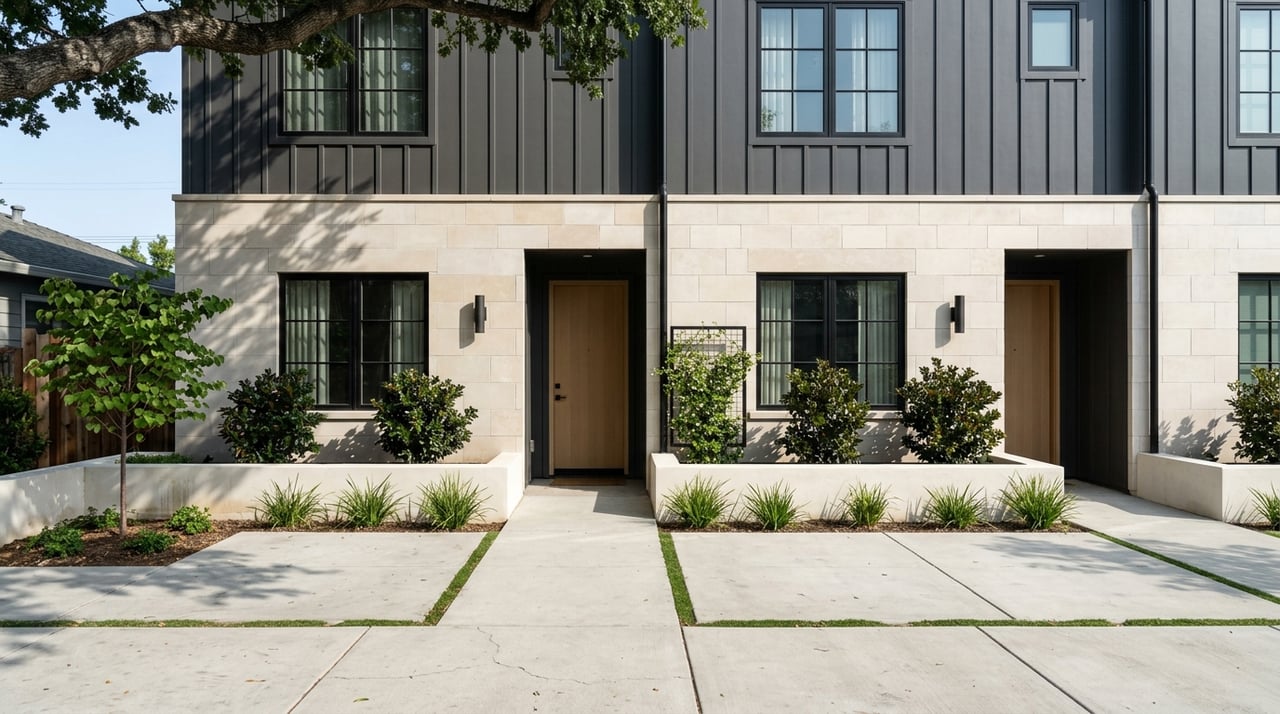
Townhomes often fit buyers who want a more accessible price point than a detached home while still getting more space and a more house-like feel than many condos. In Mountain View, townhome examples include layouts with attached two-car garages, courtyards, balconies, and multi-story floor plans. Some are designed to feel surprisingly close to a small single-family home.
That said, townhome living usually comes with more shared infrastructure and community rules. You may have less private outdoor space, and the exterior and common areas are often managed through an HOA. For many buyers, that trade-off feels worthwhile because it reduces the number of maintenance tasks they need to handle personally.
What Townhomes Often Give You
- Lower entry price than many single-family homes
- Shared exterior maintenance in many communities
- Features like attached garages, balconies, or courtyards
- Locations closer to transit-oriented or mixed-use parts of Mountain View
- A balance between space and convenience
Privacy and Outdoor Space
One of the biggest differences between these property types is how private your home feels. Detached homes usually provide more separation from neighbors and more control over your outdoor areas. If a private yard is high on your list, single-family homes are usually the clearer fit.
Townhomes can still offer useful outdoor space, but it is typically smaller and more structured. In Mountain View, attached-home examples included fenced courtyards and balconies rather than full private yards. Some homes also benefit from thoughtful layout choices, such as no direct neighbors in front or behind, but the overall experience is still more shared than with a detached property.
Monthly Costs: Price vs HOA Dues
The purchase price is only part of the financial picture. In Mountain View, townhomes and condos often have HOA dues that should be treated as part of your monthly housing cost, not as an afterthought. Depending on the community, those dues can change the affordability equation more than buyers expect.
Current public examples show how wide that range can be. A townhome at 107 Infinity Way was listed with $341 per month in HOA dues, while 244 View St carried $820 per month. A condo example, 124 Flynn Ave Unit A, had $558 per month in HOA dues.
Those dues may cover items such as:
- Common area electricity
- Landscaping
- Exterior maintenance
- Roof
- Management
- Common area insurance
- Garbage
- Reserves
- In some communities, water, sewer, hot water, or amenities like pools
Single-family homes usually do not come with HOA dues in the same way, but that does not mean ownership is cheaper month to month. It means more costs are handled directly by you, including exterior upkeep, landscaping, and repairs.
Maintenance and Responsibility
If you want the lightest day-to-day maintenance load, a townhome may feel more manageable. In many attached communities, the HOA handles common areas and may also handle exterior items depending on the governing documents. Under California HOA rules, responsibilities are typically defined by the community’s CC&Rs, bylaws, and the Davis-Stirling framework, with common areas usually maintained by the association and separate interests typically maintained by the owner unless the declaration says otherwise.
With a single-family home, more responsibility shifts to you. That often includes the roof, exterior, yard, and many site-related issues. Some buyers prefer that independence because it gives them more control, while others prefer the simplicity of shared maintenance.
Mountain View’s own trash and recycling setup also reflects this difference. Residential properties with up to four units per parcel typically use curbside carts, while larger apartment and condo buildings with nine or more units use shared bins and dumpsters. It is a small detail, but it helps show how attached living often comes with more shared services and logistics.
Remodeling Flexibility
If customization matters to you, detached ownership usually has the advantage. Mountain View’s single-family residential guidance says the city does not require discretionary design review for compliant single-family remodels or additions, and it does not require noticing adjacent neighbors for that process. For buyers who are thinking ahead about updates, additions, or reworking outdoor space, that can be an important benefit.
Townhomes can still be updated inside, but exterior changes and common-area issues often involve HOA review in addition to normal property-level considerations. That extra layer does not make improvements impossible, but it can limit your options or lengthen the process. If design freedom is a major priority, a single-family home may be the better long-term fit.
Parking and Daily Logistics
Parking is one of the most practical lifestyle differences in Mountain View. The city’s single-family guide says a single-family home must have at least one covered and one uncovered parking space. That requirement supports the more lot-based, self-contained feel of detached ownership.
Townhomes often solve parking differently. Many current examples include attached garages or underground parking, which can be convenient, especially in denser parts of the city. Still, the overall parking experience may depend more on community design than on your own lot configuration.
Where Each Style Shows Up in Mountain View
Mountain View is not uniform, and housing choices often line up with different parts of the city. If you are trying to decide between a detached home and a townhome, it helps to understand where each style tends to appear.
Areas With More Single-Family Homes
The city’s planning documents describe several areas as mostly or heavily single-family, including:
- Miramonte/Springer, which is described as almost purely single-family ranch-style housing
- Grant/Sylvan Park, which is mostly single-family in its residential portions
- Lower-density parts of Central Neighborhoods farther from Castro Street
- Monta Loma/Farley/Rock, which includes Eichlers, ranch homes, and some medium-density buildings
These areas often align with buyers who want a more traditional neighborhood pattern and detached housing stock.
Areas With More Attached Homes
Townhomes, condos, and other attached housing are more common in:
- Downtown and Castro-adjacent blocks
- San Antonio/Rengstorff
- The Crossings near San Antonio Caltrain
- North Whisman/Moffett-Whisman
The city describes these areas as having a more transit-oriented, mixed, or multi-family character. If you value access to retail, transit, or a lower-maintenance home style, these locations may naturally rise to the top of your search.
Which Option Fits Your Goals?
A single-family home may be the better fit if you want land, privacy, outdoor space, and more long-term flexibility. In Mountain View, it is also the option that usually commands the highest price. For buyers who plan to stay put, personalize the property, or prioritize separation from shared walls and shared rules, that premium can make sense.
A townhome may be the better fit if you want a lower entry point, a more manageable maintenance profile, and a layout that still feels home-like. In Mountain View, many townhomes offer practical features like attached garages, open-concept living areas, and small private outdoor zones. If you want a middle ground between a condo and a detached home, this can be a smart path.
The right answer depends on how you live, what you want your monthly costs to look like, and how much control you want over the property. In a market like Mountain View, choosing well means looking beyond the list price and focusing on the full ownership experience.
If you want help comparing specific Mountain View homes, weighing HOA trade-offs, or deciding which property type best supports your long-term plans, Fabiane Maluchnik can help you make a clear, confident decision.
FAQs
What is the price difference between single-family homes and townhomes in Mountain View?
- Current public market snapshots showed a median asking price of about $1.41 million for townhouses, while single-family examples ranged from about $2.298 million to $3.788 million, with a March 2026 median single-family residence sale price of $2.95 million.
Do Mountain View townhomes usually have HOA dues?
- Yes. Current examples showed HOA dues ranging from $341 to $820 per month for townhomes, and those dues may cover items like landscaping, exterior maintenance, insurance, garbage, roof, and reserves.
Can a Mountain View townhome still have outdoor space?
- Yes, but it is usually smaller or more structured than with a detached home, such as a courtyard, balcony, or shared amenity area rather than a full private yard.
Are single-family homes easier to remodel in Mountain View?
- Often, yes. The city says compliant single-family remodels or additions do not require discretionary design review, while attached homes may also involve HOA rules and approvals for exterior or shared-property issues.
Which Mountain View areas have more townhomes and attached housing?
- Attached housing is more common in Downtown and Castro-adjacent areas, San Antonio/Rengstorff, The Crossings near San Antonio Caltrain, and North Whisman/Moffett-Whisman.
Which Mountain View areas have more single-family homes?
- Single-family housing is especially common in Miramonte/Springer, Grant/Sylvan Park, lower-density parts of Central Neighborhoods, and parts of Monta Loma/Farley/Rock.